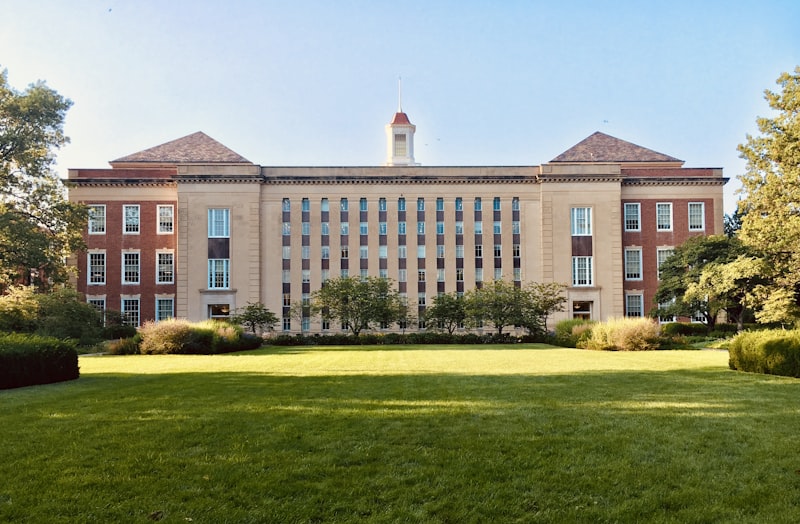
A college or university campus is a complex, multi-layered environment where thousands of young adults pursue higher education, engage in research, build professional skills, and prepare for their futures. Unlike a school, a college campus encompasses lecture halls, seminar rooms, advanced laboratories, libraries, administrative blocks, hostels, cafeterias, auditoriums, sports complexes, and placement cells — each serving a distinct function and collectively shaping the institutional experience.
College Vastu consultation involves a meticulous examination of how these diverse zones are oriented, interconnected, and utilised across the campus. Through a detailed physical site visit, we observe how the directional alignment and spatial arrangement of academic buildings, residential blocks, research facilities, and administrative areas may be supporting or disrupting the flow of constructive energy across the institution.
Our approach is rooted in practical, non-disruptive adjustments suited to the scale and operational demands of a higher education institution. The goal is to foster conditions where students feel intellectually stimulated, faculty members feel valued and productive, research environments feel conducive to innovation, and the institution as a whole functions with greater cohesion and purpose.
College administrators and academic leaders sometimes encounter persistent issues that may appear disconnected but can often be traced to spatial imbalances across the campus. Here are some common concerns we address.
Every college campus is unique in its scale, infrastructure, and academic character. Our consultation process is thorough, personalised, and grounded in on-site observation — not generic advice.
We begin with an in-depth conversation with the college management, dean, or governing body to understand the institution's history, academic programmes, campus layout complexities, current challenges, and the outcomes they wish to encourage. This dialogue ensures our on-site assessment is focused and contextually informed.
A thorough on-site visit is conducted to walk through the entire campus — the main entrance, administrative block, lecture halls, seminar rooms, department buildings, laboratories, research centres, library, computer centres, hostels (boys' and girls'), cafeteria, auditorium, sports grounds, placement cell, examination halls, staff quarters, and utility zones. We observe how each space is positioned, used, and interconnected.
We assess the directional alignment of every key functional zone across the campus, analyse how academic wings, residential blocks, and administrative areas interact, and evaluate the flow of movement and energy between buildings. This includes examining the placement of knowledge-oriented spaces, fire and water elements, open grounds, entry and exit points, and zones associated with growth, stability, and intellectual activity.
Based on our observations, we identify spatial imbalances and areas where the current configuration may be working against natural energy principles. Every finding is documented clearly and presented to the college leadership in straightforward, practical terms — explaining how specific campus arrangements may be influencing academic performance, research output, hostel conditions, or administrative efficiency.
We provide actionable, context-sensitive corrections tailored to the specific layout, constraints, and operational needs of your institution. Recommendations focus on achievable adjustments — repositioning key elements, rearranging seating orientations in lecture halls, optimising hostel room layouts, and minor modifications to administrative and research zones — rather than large-scale structural overhauls. You receive a clear, prioritised plan that can be implemented in phases, ideally during semester breaks, without disrupting academic operations.
A well-aligned college campus can positively influence multiple dimensions of institutional life. Here's what our clients commonly experience.
When lecture halls, libraries, and study areas are aligned with supportive directional principles, students may find it easier to concentrate, absorb complex material, and perform more consistently in examinations — fostering a culture of genuine intellectual engagement across the institution.
Laboratories, research centres, and innovation hubs positioned in alignment with Vastu principles can help create an atmosphere that supports deeper thinking, sustained focus, and creative problem-solving — encouraging meaningful research output and academic contributions.
Hostel blocks that are spatially balanced tend to foster better rest, fewer interpersonal disputes, and a healthier living environment — which is essential for students who spend months residing on campus and need a stable foundation for both study and personal growth.
A balanced campus environment can contribute to reduced stress and greater professional fulfilment among faculty members. When department offices, staffrooms, and teaching areas feel harmonious, experienced professors are more likely to remain committed and bring their best to both teaching and mentorship.
Correcting Vastu imbalances in zones associated with growth, opportunity, and outward connections can help create conditions where placement cells function more effectively, campus recruitment drives attract better companies, and graduates feel more confident stepping into their careers.
A spatially balanced campus supports smoother governance, stronger community trust, and a positive institutional image. This can contribute to healthier admission numbers, improved accreditation prospects, and the long-term standing of your college or university in the academic landscape.
College and university campuses are significantly larger and more complex than school premises. They include hostels where students live for extended periods, advanced research laboratories, multiple department buildings, placement cells, auditoriums, and administrative blocks with layered governance structures. Our College Vastu consultation addresses these campus-wide dynamics — including hostel well-being, research productivity, inter-departmental harmony, and placement effectiveness — which are not typically part of a school-level assessment.
Yes. A physical site visit is a fundamental part of our consultation process. Walking through the entire campus first-hand allows us to assess the layout, directional alignment, building interconnections, hostel environments, and how each zone is actually used — which is essential for providing accurate and institution-specific guidance that cannot be replicated through remote assessments alone.
Our approach prioritises practical, achievable adjustments. In most cases, we recommend repositioning key elements, rearranging layouts within classrooms and hostels, optimising the usage of existing spaces, and minor modifications that can be implemented during semester breaks. Major structural changes or demolition are rarely necessary, and we always work within the constraints of your current campus infrastructure.
Absolutely. While incorporating Vastu during the planning and construction stage is ideal, the vast majority of our consultations are for established, fully operational institutions. We work within the realities of your existing campus and recommend corrections that are feasible without major disruption to academic schedules, hostel operations, or administrative workflows.
No. Vastu consultation does not guarantee specific academic outcomes, placement figures, or behavioural changes. What it aims to do is create spatial conditions that support a calmer, more focused, and balanced campus environment — which can complement the efforts of faculty, administration, and students. Tangible results depend on many factors working together, and Vastu is one supportive element in that broader equation.
Reach out to us for a personalised College Vastu consultation. We're here to help you create a more focused, harmonious, and thriving academic environment for your students, faculty, and institution.